Skip to contentPrivate previewIxvane isn’t publicly available yet. The screens on this page are design previews with sample data.Become a design partner →
ixvane

The managed MCP gateway · onboarding design partners

Governed context for every AI agent

Routed, governed and redacted for every AI agent. Ixvane plugs your internal databases, component libraries and browser fleets into AI coding workflows — without handing models the keys.

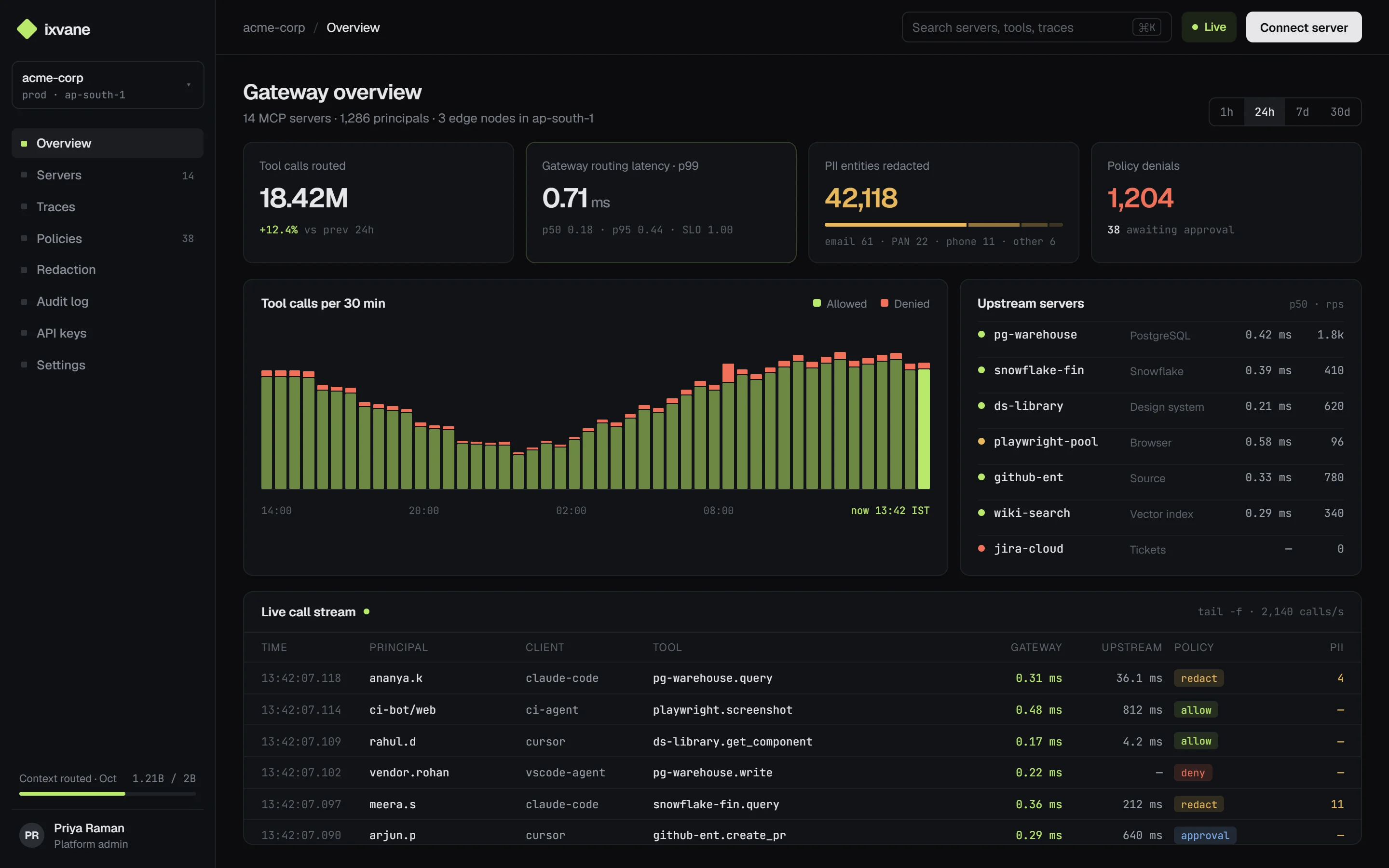
console.ixvane.inconsole.ixvane.in · design preview
Ixvane console design preview: gateway overview with tool-call volume, routing latency, PII redactions, server health and a live call stream
Design preview of the Ixvane console. Sample data, not a live system.

Designed for any MCP client and transport

  • claude-code
  • cursor
  • vs code
  • windsurf
  • zed
  • jetbrains
  • custom agents

stdio · sse · streamable-http

Why we’re building Ixvane

Your agents already have access. Do you know to what?

MCP made it trivial to give an AI agent a database, a design system or a browser. It also made it trivial to do that with production credentials in a dotfile. Ixvane puts one governed layer between agents and everything they touch.

  • Shadow MCP servers

    01

    Developers run local servers with production credentials. Nobody knows how many exist or what they can reach.

    ~/.cursor/mcp.json "url": "postgres://admin:•••@prod-db"
  • Customer data in prompts

    02

    Query results with names, PANs and phone numbers flow straight into third-party model context windows.

    tool_result { "pan": "ABCPK4821F", "phone": "+91 98•••" }
  • No audit trail

    03

    When an agent drops a table or reads a salary column, security can’t answer who, when, or why.

    audit.log — no entries —
How it works

One gateway between every agent and every system

Agents connect to a single MCP endpoint instead of dozens of servers. Each tool call passes through five stages before it reaches your systems — and again on the way back. Our target: all five in under a millisecond.

Agents & IDEs

  • claude-code
  • cursor
  • vs code agent
  • ci-agent
  • internal-copilot

ixvane gateway

one governed MCP endpoint

  1. authenticate0.07 ms
  2. authorize0.06 ms
  3. redact0.08 ms
  4. route0.03 ms
  5. observe0.02 ms
target budget per stagethis call 0.24 ms

Your MCP servers

  • pg-warehouse
  • snowflake-fin
  • ds-library
  • playwright-pool
  • github-ent
  1. 01

    Authenticate

    OIDC or SAML through your IdP. Short-lived tokens per developer, agent and CI job.

  2. 02

    Authorize

    Role × tool × argument policies, evaluated in-process — no network hop.

  3. 03

    Redact

    Streaming detectors on requests and responses, with stable per-session tokens.

  4. 04

    Route

    Pooled upstream connections on in-region edge nodes, with failover.

  5. 05

    Observe

    Every call traced end to end. Export to OpenTelemetry and your SIEM.

Product tour

A look at the console we’re building

These are design previews of the Ixvane console, shared early so you can tell us what you need. Step through the four things a platform team does every day.

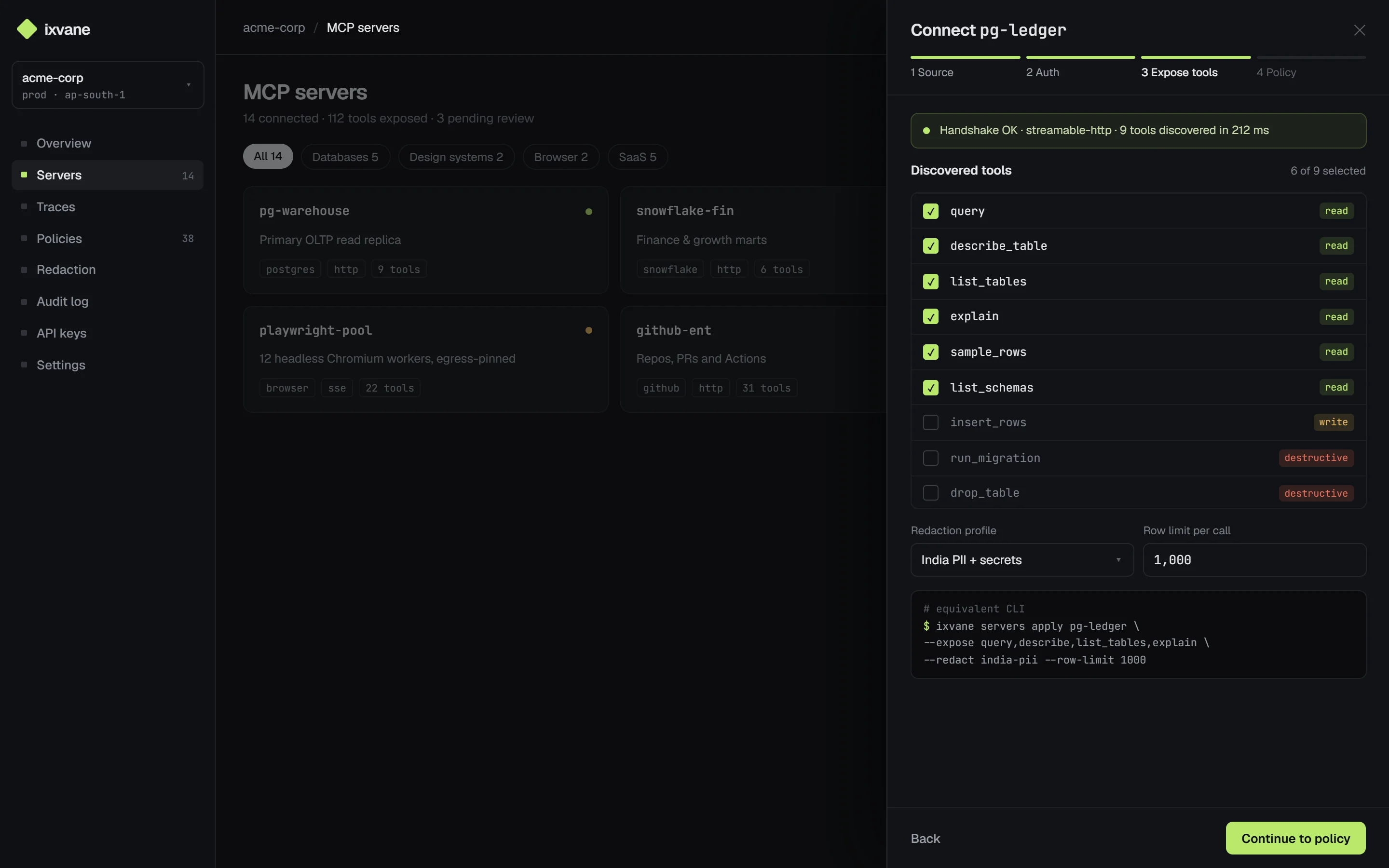
console / servers / connect
Design preview: connect-server drawer listing discovered tools with risk tags, redaction profile and row limit
step 1 · connect

Register a server and choose what agents can see

Point Ixvane at any MCP server. It discovers the tools, and you decide which ones go live — before any agent can call them.

  1. 01Discovered tools are tagged read, write or destructive, so risky ones stay off by default.
  2. 02Each server gets a redaction profile and a row limit per call.
  3. 03Every choice maps to a CLI command you can commit to Git.
1 / 4
What you’ll get

The context layer, governed

Every tool call authenticated, authorized, scrubbed and recorded — without slowing your agents down.

target gateway overhead · p99<1 ms

auth0.07 ms
policy0.06 ms
redact0.08 ms
route0.03 ms

Sub-millisecond context routing

In-region edge nodes terminate MCP sessions, then authorize and route each call in-process. Governance shouldn’t show up in your agent’s latency budget.

response → model
"email"ananya.k@acme.inEMAIL_01
"pan"ABCPK4821FPAN_01
"aadhaar"4821 9930 1172AADHAAR_01
"upi_id"ananya@okaxisUPI_01

PII redacted before any model sees it

India-first detectors — Aadhaar, PAN, UPI, GSTIN — plus emails, cards and secrets, on requests and responses. Values become stable tokens, so agents can still reason over them.

Connect the systems your agents actually need

Bring any MCP server, or start from first-party connectors for Postgres, Snowflake, Storybook and Playwright. Tell us which ones you need next — design partners set the connector roadmap.

Request a connector →
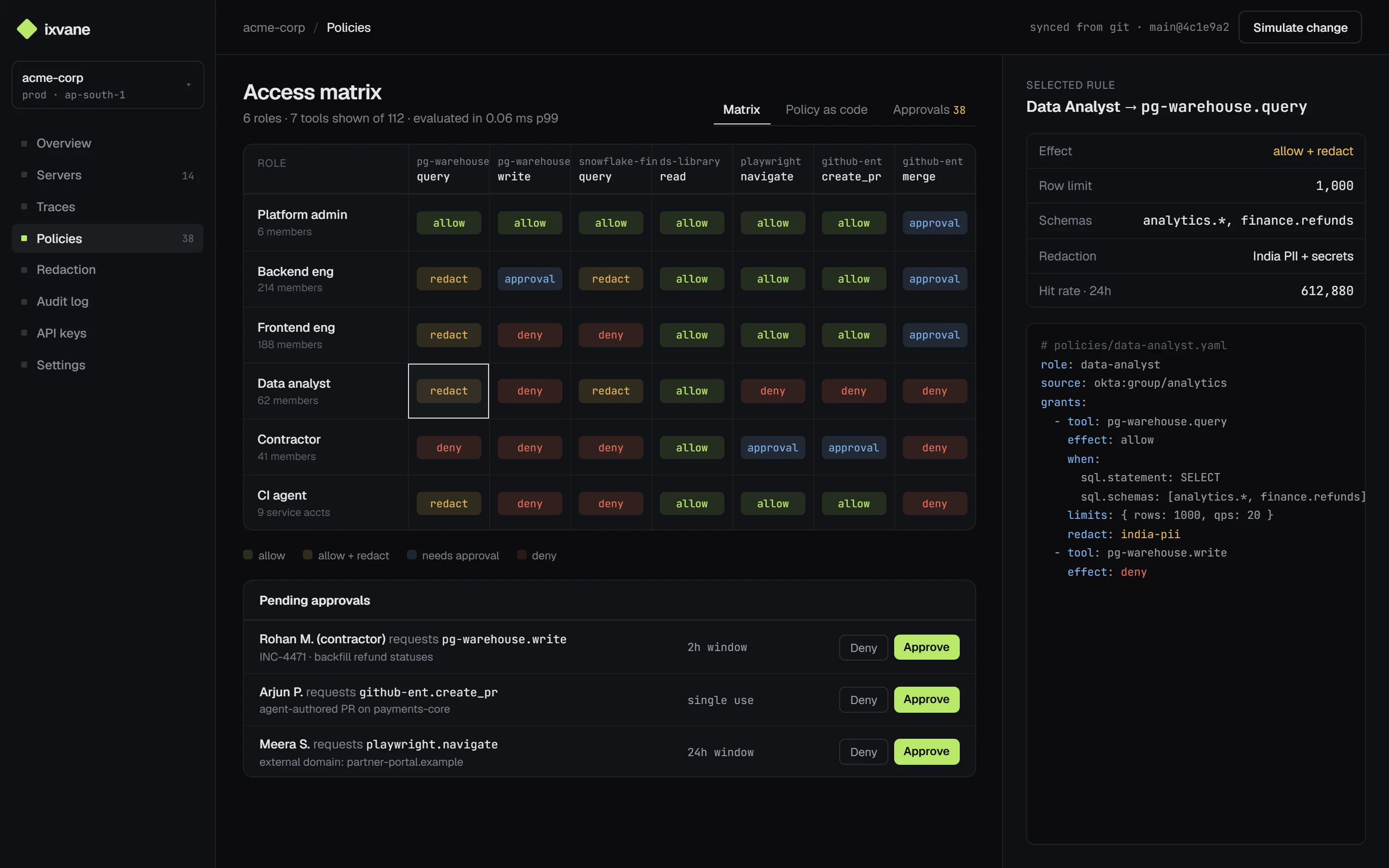
Sample policy matrix: roles by tool action
Rolequerywritebrowsemerge
adminallowallowallowapproval
backendscopedapprovalallowallow
analystscopeddenydenydeny
vendordenydenyapprovaldeny

RBAC that follows your IdP

Okta and Entra groups become roles. Grant per tool, per schema, per row limit — with just-in-time approvals for anything that writes.

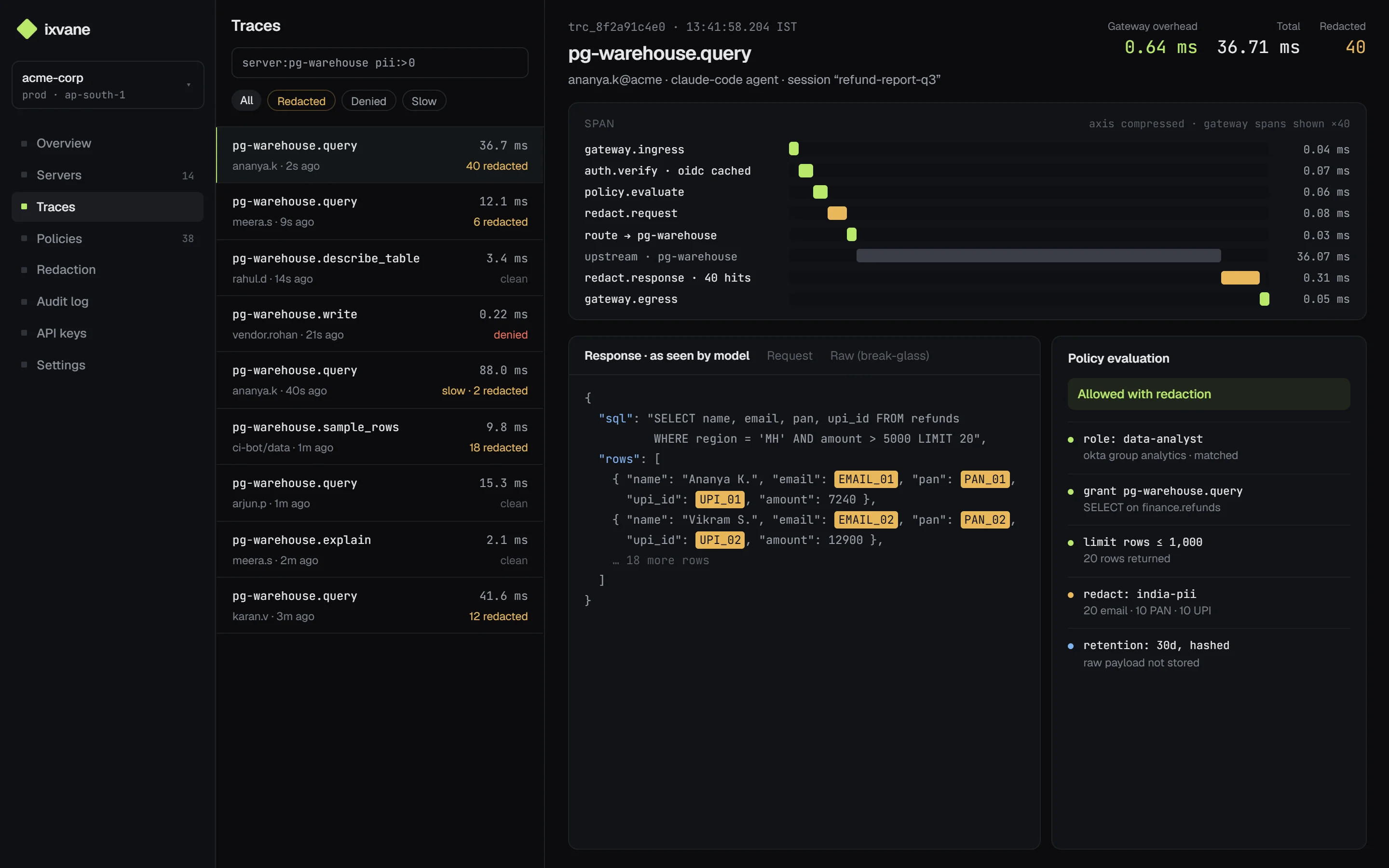
Prompt telemetry for every call

Trace each tool call from prompt to upstream and back. See which agents touch which data, what got redacted, and where tokens go.

Built on Claude

Telemetry that understands the prompt, not just the payload

Ixvane is architected natively around the Anthropic Messages API and the Model Context Protocol. Claude Sonnet and Haiku run beside the gateway — never in its request path — and only ever see redacted payloads.

how ixvane uses claude

Two models, three jobs, zero raw PII

  1. 01

    Prompt quality, scored in real time

    claude haiku

    Haiku grades each prompt for clarity, scope and risk as sessions stream in, so you can see which agents burn tokens or reach for more data than the task needs.

  2. 02

    Multi-turn context, compressed

    claude sonnet · extended thinking

    Sonnet condenses long sessions and bulky tool results into compact, faithful summaries, keeping the facts that matter across high-throughput MCP tool executions.

  3. 03

    Structured JSON telemetry

    native tool use

    Schema-bound tool calls turn every session into typed records — intents, tools, tokens, redactions and scores — ready for OpenTelemetry, your warehouse or your SIEM.

telemetry · trc_8f2a91c4e0.json
{  "principal": "ananya.k",  "client": "claude-code",  "tool": "pg-warehouse.query",  "prompt_quality": {    "model": "claude-haiku",    "score": 0.86,    "flags": ["unbounded_date_range"]  },  "context": {    "model": "claude-sonnet",    "turns": 42,    "tokens_in": 184210,    "tokens_out": 19876,    "cache_read_tokens": 15360  },  "pii_redacted": { "email": 2, "pan": 1 },  "gateway_ms": 0.31}
sample telemetry record · illustrative data
  • messages api

    Native integration

    Built directly on the Anthropic Messages API, so every model call is versioned, traced and governed like any other tool call.

  • tool use

    Typed output

    Native tool calling with strict JSON schemas, so telemetry arrives structured instead of scraped from prose.

  • extended thinking

    Deeper reasoning

    Reserved for the hard part: compressing long, tool-heavy sessions without dropping facts.

  • prompt caching

    Cached prefixes

    Tool schemas, policies and redaction profiles are cached as stable prefixes, cutting latency and cost per evaluation.

Built for every team

One gateway, five teams on the same page

for platform engineering

Give every team MCP without running forty servers yourself

  • One managed endpoint per environment, pooled upstream connections
  • Terraform provider, CLI and API for everything in the console
  • Failover across in-region edge nodes
terraform/ixvane.tf
resource "ixvane_server" "pg" {  name      = "pg-warehouse"  transport = "http"  expose    = ["query", "describe"]  redact    = "india-pii"}
Setup

Designed to be live in an afternoon

  1. 01

    Register your MCP servers

    Point Ixvane at any stdio, SSE or HTTP server — or pick a first-party connector. Credentials stay in your vault.

  2. 02

    Attach policies as code

    Roles from your IdP, grants per tool, redaction profiles. Synced from Git and simulated before they ship.

  3. 03

    Point your agents at one endpoint

    Every IDE and agent gets a single governed MCP URL. Telemetry starts with the first call.

ixvane cli · preview
$ ixvane servers add pg-warehouse \    --url $PG_REPLICA_URL --transport http  ✓ handshake ok · 9 tools discovered$ ixvane policy apply -f policies/  ✓ 6 roles · 41 grants · redact: india-pii$ ixvane clients token --team backend  endpoint  https://acme.mcp.ixvane.in/v1  token     ixv_live_••••••••••••3f9a
Preview of the Ixvane CLI registering a server, applying policies and issuing an agent token.
design target for general availability

Under one millisecond: p99 gateway overhead, including auth, policy and redaction.

  • India-firstPII detectors for Aadhaar, PAN, UPI and GSTIN
  • In-regionProcessing and storage in India by default
  • 0Raw prompts stored unless you opt in
  • 1Endpoint for every agent, IDE and CI job
Security by design

Built to pass the security review

Your CISO gets the controls; your developers get the context. Ixvane is being built to process everything in-region and store no raw prompts by default.

  • SOC 2 Type II · planned
  • Built for the DPDP Act
  • Data residency · India
  • 01

    Policy as code

    YAML policies synced from Git, reviewed in pull requests, and dry-run against recent traffic before they go live.

  • 02

    Every call audited

    Immutable, hash-chained audit logs of who called which tool with what scope. Stream them to your SIEM.

  • 03

    Data stays in-region

    In-region processing with customer-managed keys, VPC peering and private connectivity to your databases.

Roadmap

Where we are, and what’s next

We’re building in the open with a small group of design partners. Timelines are targets, not promises.

  1. Now
    Q4 2026

    Private preview

    • Design partners onboarding
    • Gateway, RBAC and India PII redaction
    • Postgres & Snowflake connectors
  2. Next
    Q1 2027

    Public beta

    • Self-serve sign-up
    • Storybook & Playwright connectors
    • Trace explorer and audit export
  3. Later
    Q2 2027

    General availability

    • SOC 2 Type II audit
    • Just-in-time approvals
    • Terraform provider
  4. Exploring
    2027+

    Enterprise

    • Self-hosted data plane
    • Customer-managed keys
    • Custom detectors
Design partner program

Help us build the gateway you’d actually buy

We’re looking for 10 engineering teams already running AI coding agents against internal systems. Partners get:

  • Free access throughout the private preview
  • A shared channel with the founding team
  • A real say in connectors and roadmap
  • Launch pricing locked in for your team

Join the waitlist

I’m mostly interested in

No spam. We reply personally within a week.

FAQ

Questions we hear most

Is Ixvane available today?

Not yet. We’re in private preview with a small group of design partners. The screens on this page are design previews with sample data — they show what we’re building, not a live system.

What does a design partner commit to?

A 30-minute call every two weeks and honest feedback. In return you get free access during the preview, a direct line to the founders, and launch pricing locked in.

Will Ixvane see or store our data?

Tool payloads are designed to be processed in memory on in-region edge nodes. By default only hashed, redacted traces are kept; raw payload capture is off unless you turn it on for a specific server.

How does Ixvane use Claude?

Ixvane is built natively on the Anthropic Messages API and the MCP specification. Claude Haiku scores prompt quality in real time, Claude Sonnet with extended thinking compresses long multi-turn sessions, and native tool calling turns each session into structured JSON telemetry, with prompt caching keeping tool schemas and policies warm. These model calls run beside the gateway, not in its request path, and only ever see redacted payloads.

Which MCP clients will work?

Anything that speaks MCP — Claude Code, Cursor, VS Code agents, Windsurf, Zed, JetBrains and your own agents — over stdio (through a local sidecar), SSE or streamable HTTP.

Can we self-host?

A self-hosted data plane inside your VPC or on-prem Kubernetes is on the roadmap for general availability. If it’s a requirement for you, tell us — it moves up the list.

How will pricing work?

We plan to price per developer, with unlimited tool calls and free service accounts for agents and CI. Design partners keep their launch pricing.

Every agent gets the context it needs. Nothing it shouldn’t.

We’re onboarding design partners now. Tell us what your agents need to reach.